Stainless Steel vs Wooden Kitchen: MDF, HDF, Plywood or Steel – Which Is Best?
Choosing the right material is one of the most important decisions when designing a modern kitchen. You can change the colour of your shutters, upgrade your accessories or even redesign parts of the layout later. But the material that forms the core of your cabinets determines how your kitchen performs for years.
For most Indian homeowners, the options eventually come down to MDF, HDF, plywood or stainless steel.
While MDF, HDF and plywood are widely used in modular kitchens, they are all wood-based materials and come with varying levels of resistance to water, termites, heat and long-term wear. Stainless steel emerges as the clear winner for homeowners looking for a modern kitchen that prioritises durability, hygiene, waterproof performance and low maintenance.
That doesn't mean every wood-based material is unsuitable. Each has its own advantages, applications and price point. The smarter approach is to understand what is actually inside your kitchen before deciding what is best for your home.
Let's compare them in detail.
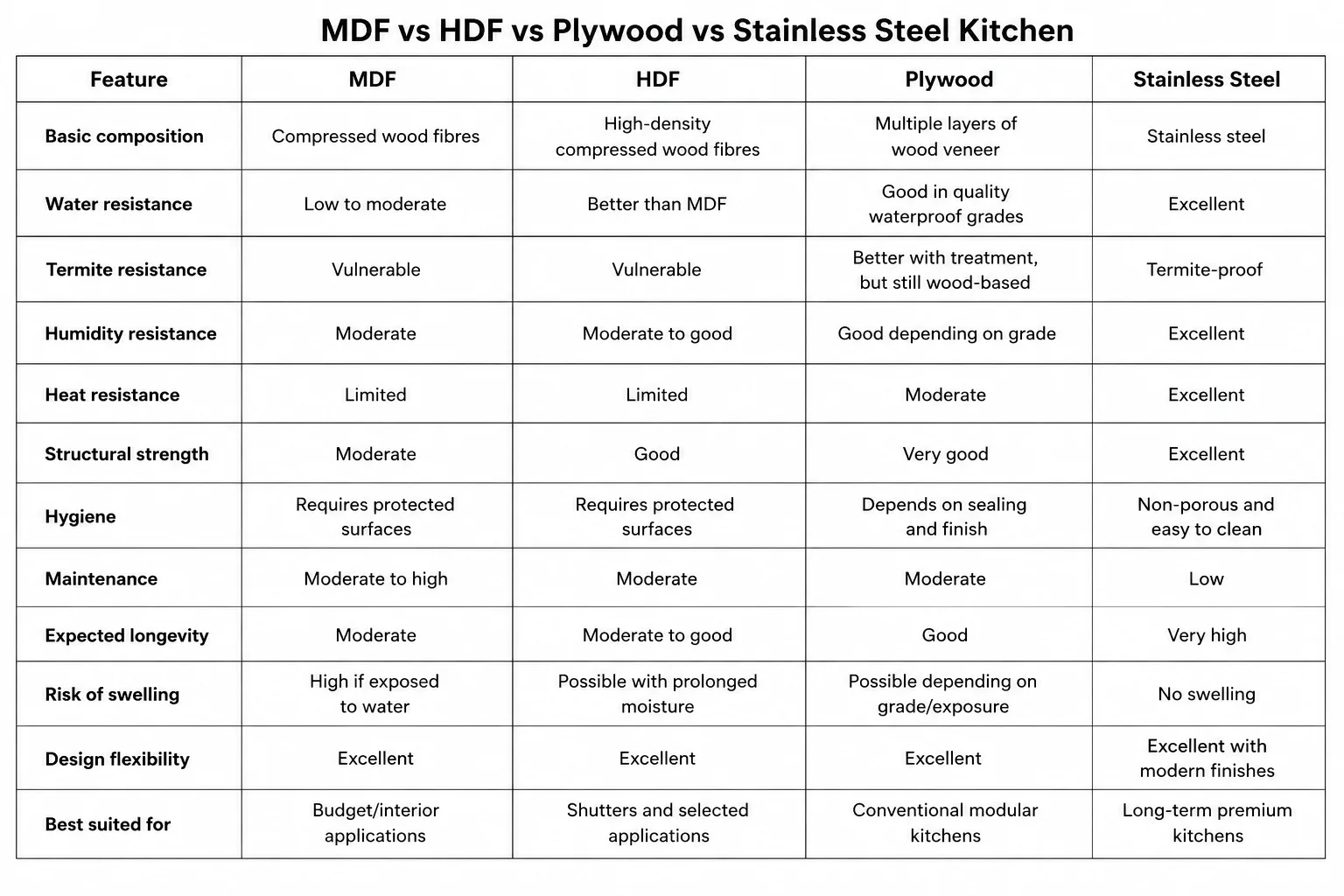
×
MDF Kitchens: Affordable and Versatile, But Sensitive to Water
MDF, or Medium Density Fibreboard, is manufactured by breaking wood into fibres and combining them using resins under heat and pressure.
One of MDF's biggest advantages is its smooth, uniform surface. It works well with paint, laminates and decorative finishes and can be shaped relatively easily. This makes it popular for furniture and kitchen shutters where aesthetics and affordability are important.
However, MDF has a significant weakness in kitchens: moisture.
Once water penetrates an inadequately protected MDF board, it can swell and lose its original structure. This makes areas around the sink and other moisture-prone sections particularly important.
Pros of MDF
Economical compared with many premium materials
Smooth surface for decorative finishes
Consistent appearance
Easy to machine and design
Cons of MDF
Vulnerable to prolonged moisture exposure
Can swell when water reaches the core
Not naturally termite-proof
Lower structural strength than plywood and stainless steel
Damage from water can be difficult to reverse
MDF can therefore have applications within a kitchen, but homeowners looking for a kitchen carcass designed for decades of heavy use should understand its limitations.
HDF Kitchens: Denser and Stronger Than MDF
HDF, or High Density Fibreboard, is similar in principle to MDF but manufactured at a higher density.
It offers better strength and impact resistance than standard MDF and can work well for certain shutters, panels and interior applications.
But being denser does not turn HDF into stainless steel.
HDF remains a wood-fibre product. Prolonged water penetration can affect it, and termite protection remains relevant.
Pros of HDF
Denser and stronger than MDF
Smooth surface
Suitable for detailed finishes
Good dimensional consistency
Cons of HDF
Still susceptible to prolonged moisture
Not inherently termite-proof
Damaged sections may require replacement
Cannot offer the inherent heat and water resistance of stainless steel
HDF improves upon some characteristics of MDF, but the fundamental limitations of wood-based fibreboards remain.
Plywood Kitchens: The Traditional Modular Kitchen Favourite
Among wood-based options, plywood is generally one of the strongest and most widely preferred materials for quality modular kitchen cabinetry.
Plywood is manufactured by bonding multiple layers of wood veneer together. Different grades offer different levels of moisture resistance, which is why terms such as BWR and BWP plywood frequently appear during kitchen planning.
Good-quality plywood can provide excellent strength and a long usable life when manufactured, sealed and installed correctly.
However, plywood is still fundamentally wood-based.
Water entering exposed edges or poorly sealed areas can eventually cause problems. Termite resistance depends on material quality and treatment, and homeowners need to ensure that the grade promised by the manufacturer is actually being used.
Pros of Plywood
Stronger than MDF for structural cabinetry
Good screw-holding capacity
Wide availability
Compatible with numerous decorative finishes
Quality waterproof grades perform well in kitchens
Cons of Plywood
Quality varies considerably by grade and manufacturer
Still susceptible to termites without adequate protection
Prolonged water exposure can affect poorly protected sections
Laminates and external finishes may require maintenance
Performance depends heavily on sealing and workmanship
For homeowners committed to a wooden modular kitchen, good-quality plywood is generally a stronger choice than basic MDF for the primary structure.
But there is another option.
Stainless Steel Kitchens: Built Differently from the Core
A stainless steel kitchen isn't simply a wooden kitchen with metal on the outside.
The fundamental difference is the core material itself.
When the cabinets, carcasses and structural elements are engineered in stainless steel, several common problems associated with wood-based kitchens disappear at the material level.
1. Stainless Steel Is Waterproof
Water is unavoidable in an Indian kitchen.
Sink splashes, wet utensils, steam, floor cleaning, plumbing leaks and monsoon humidity all expose cabinetry to moisture.
Stainless steel does not absorb water. It therefore does not swell, rot or lose structural integrity simply because it becomes wet.
For a space that works with water every day, this is one of its biggest advantages.
2. Termites Cannot Eat Stainless Steel
MDF, HDF and plywood all originate from wood.
Stainless steel doesn't.
That means the cabinet structure itself provides no food source for termites. There is no requirement for periodic termite treatment simply to protect the steel cabinetry.
For homeowners who have experienced termite damage before, this alone can fundamentally change the ownership experience.
3. Better Suited to Indian Cooking Conditions
Indian kitchens work hard.
Tadkas, frying, steam, heavy utensils, masalas, oils and several cooking sessions a day create a demanding environment.
Stainless steel performs extremely well around heat and is non-combustible. It also handles everyday moisture and heavy usage without the same structural concerns associated with wood-based boards.
4. A More Hygienic Kitchen Core
Hygiene is another reason stainless steel has been used extensively in professional food environments.
Its surface is non-porous and easy to clean. It doesn't inherently absorb kitchen spills, moisture or cooking odours.
For modern homeowners increasingly thinking about wellness and cleanliness, the material inside the cabinets matters just as much as the visible countertop.
5. No Swelling, Warping or Rotting
A kitchen cabinet can look beautiful externally while damage slowly develops internally.
Water penetration into wood-based materials can lead to swelling, deformation or deterioration.
Stainless steel eliminates these particular problems.
Even in areas exposed to frequent moisture, the material retains its structural form.
6. Low Maintenance Over the Long Term
Kitchen price should never be evaluated only on Day 1.
Consider what happens over the next 10, 15 or 20 years.
Wood-based kitchens may require attention because of moisture damage, laminate deterioration, pest issues or damaged panels.
A stainless steel kitchen removes many of these potential maintenance points.
There is no wood to rot, no cabinet core to swell and no steel carcass for termites to consume.
That can mean fewer repairs and considerably less worry over the lifetime of the kitchen.
But Doesn't Stainless Steel Look Industrial?
This is where modern stainless steel kitchens are very different from the steel kitchens many homeowners remember.
Stainless steel no longer means exposed silver cabinets.
At Verantes Living, the material can be transformed through 5000+ finish possibilities, allowing homeowners and architects to explore:
Matte finishes
Gloss finishes
Metallic tones
Warm neutral shades
Fluted surfaces
Etched patterns
Textured shutters
Dual-tone combinations
Classical and contemporary design languages
The visible kitchen can therefore feel warm, luxurious and completely integrated with the rest of the home while retaining stainless steel underneath.
You don't have to choose between the warmth of design and the performance of steel.
What About the Cost?
This is one area where wood-based kitchens can have an advantage initially.
MDF offers accessible options, while plywood kitchens are available across an enormous price range. A premium stainless steel kitchen generally requires a higher upfront investment.
But initial cost and lifetime cost are not the same thing.
A homeowner should consider:
Termite treatment
Water-damaged cabinet replacement
Repairs
Refacing
Finish deterioration
Expected lifespan
Long-term maintenance
If a kitchen needs substantial repair or replacement after several years, its lower initial cost becomes less meaningful.
A stainless steel kitchen should therefore be evaluated as a long-term investment rather than compared only on the first quotation.
Which Material Is Best for Kitchen Cabinets?
The answer becomes clearer when you define what "best" means.
If your priority is the lowest initial budget, MDF can have a role.
If you want a stronger wood-based solution, quality plywood remains a practical and widely used option.
If you want water resistance, termite resistance, hygiene, structural durability, low maintenance and long-term performance together, stainless steel stands ahead of MDF, HDF and plywood.
For modern Indian homes, that makes stainless steel one of the smartest materials to consider for the kitchen.
The Verdict: Stainless Steel Is the Winner for a Long-Term Modern Kitchen
MDF, HDF and plywood have all played an important role in modular kitchen design, and each material has situations where it makes sense.
But kitchens are changing.
Homeowners today aren't only asking:
"How will my kitchen look?"
They're also asking:
"How long will it last?"
"What happens if there's a plumbing leak?"
"Will I have to worry about termites?"
"How much maintenance will this require?"
"Will it still perform well 15 years from now?"
When these questions become part of the decision, stainless steel emerges as the winner.
It combines the practical performance modern kitchens demand with the design flexibility premium homes expect.
And that makes stainless steel more than an alternative to wood.
It makes it a smarter material for the modern kitchen.
Discover Stainless Steel Kitchens by Verantes Living
Verantes Living brings the inherent strength of stainless steel into beautifully designed residential kitchens. With customised planning, 5000+ finish possibilities, intelligent storage solutions, in-house manufacturing and a lifetime warranty, every kitchen is created to deliver both design and long-term performance.
Because the best kitchen material shouldn't force you to choose between beauty and durability.
With stainless steel, you can have both.
Frequently Asked Questions About Stainless Steel Kitchens
1. Are stainless steel kitchens good for Indian homes?
Yes. Stainless steel kitchens are particularly well suited to Indian homes because they can withstand moisture, humidity, heat and intensive everyday cooking. Stainless steel does not swell or warp due to water exposure and is naturally termite-proof, making it suitable for different Indian climatic conditions.
2. Is a stainless steel kitchen better than a wooden kitchen?
For homeowners prioritising durability, waterproof performance, termite resistance, hygiene and low maintenance, stainless steel offers significant advantages over wood-based materials such as MDF, HDF and plywood. Wooden kitchens can perform well when high-quality materials are used, but stainless steel eliminates several material-related concerns associated with moisture and pests.
3. Which stainless steel grade is best for kitchen cabinets?
The grade of stainless steel is an important consideration when buying a stainless steel kitchen. SS 304 is widely preferred for quality kitchen applications because of its corrosion resistance, durability and suitability for environments exposed to moisture. Homeowners should always ask the manufacturer about the grade and specifications of the stainless steel being used rather than assuming all steel kitchens are the same.
4. Do stainless steel kitchens rust?
Good-quality stainless steel is highly resistant to corrosion, but performance depends on the grade of stainless steel, environmental conditions, fabrication quality and maintenance. Choosing the appropriate stainless steel grade and an experienced manufacturer is particularly important in humid and coastal environments.
5. Are stainless steel kitchens waterproof?
Stainless steel itself is non-absorbent and does not swell, rot or deteriorate like wood-based boards when exposed to water. This makes stainless steel cabinets particularly useful around sinks and other moisture-prone areas. The performance of the complete kitchen also depends on its fabrication, joints, hardware and installation.
6. Are stainless steel kitchens termite-proof?
Yes. Termites feed on cellulose-containing materials such as wood and cannot consume stainless steel. A stainless steel cabinet structure therefore eliminates the risk of termite damage to the cabinetry itself.
7. Are stainless steel kitchens noisy?
Modern residential stainless steel kitchens do not have to be noisy. Quality kitchens can incorporate soft-close hinges, premium drawer mechanisms and appropriate construction techniques to provide smooth and quiet operation. The old perception of noisy metal cabinets largely comes from basic or commercial-style steel cabinetry rather than premium residential kitchen systems.
8. Do stainless steel kitchens look industrial?
Not anymore. Modern stainless steel kitchens can be created in a wide variety of colours, textures and decorative finishes. At Verantes Living, homeowners can explore 5000+ finish possibilities, including matte, metallic, textured, fluted, etched and dual-tone options. The finished kitchen can therefore look contemporary, warm, classical or luxurious rather than industrial.
9. Are stainless steel kitchens easy to clean?
Yes. Stainless steel surfaces are non-porous and easy to maintain. Most everyday spills and cooking residue can be cleaned using a soft cloth and an appropriate mild cleaner. Unlike wood-based cabinet cores, stainless steel does not absorb water from everyday spills.
10. How long does a stainless steel kitchen last?
A well-designed and properly manufactured stainless steel kitchen can provide decades of service. Stainless steel does not suffer from common problems such as termite damage, rotting or moisture-induced swelling, which contributes to its long-term durability. The actual lifespan of the complete kitchen also depends on hardware, accessories, usage and maintenance.
11. Are stainless steel kitchens expensive?
A premium stainless steel kitchen can have a higher initial cost than many MDF, HDF or plywood kitchens. However, the comparison should also consider long-term ownership costs. Reduced risk of termite damage, water-related cabinet replacement, polishing and structural repairs can make stainless steel a strong long-term investment.
12. Can stainless steel kitchens be customised?
Yes. Stainless steel modular kitchens can be customised according to the available space, cooking habits, storage requirements and design preferences of the homeowner. Layouts, cabinet sizes, internal accessories, islands, tall units, colours and finishes can all be planned around the individual home.
13. Can stainless steel kitchens have different colours and finishes?
Yes. Stainless steel kitchens are no longer restricted to the traditional silver appearance. Depending on the manufacturing and finishing technology available, homeowners can choose from matte colours, metallic shades, textured surfaces, etched patterns, fluted designs and other decorative options.
14. Is stainless steel suitable for coastal and humid cities?
Stainless steel can be an excellent material for kitchens in humid and coastal regions because it does not absorb atmospheric moisture or swell. However, selecting the appropriate stainless steel grade is particularly important in coastal environments because exposure to salt and chlorides can affect corrosion performance.
15. Is stainless steel a good choice for a luxury modular kitchen?
Yes. Modern stainless steel combines engineering performance with extensive aesthetic customisation. Premium finishes, handleless profiles, intelligent storage, integrated lighting, sophisticated hardware and bespoke layouts allow stainless steel to be used in high-end contemporary and classical kitchens alike.
16. What should I check before buying a stainless steel kitchen?
Before making a decision, ask about the stainless steel grade, thickness and construction of the cabinets, manufacturing process, hardware, finishes, installation, warranty and after-sales support. Homeowners should compare the complete kitchen system rather than choosing purely on the basis of price.
17. Is stainless steel the best material for a modern kitchen?
There is no single material that suits every budget or requirement. However, for homeowners seeking a combination of water resistance, termite resistance, hygiene, strength, low maintenance, longevity and modern design flexibility, stainless steel offers one of the most comprehensive material solutions available for contemporary kitchens.